

-
Description
Raman spectroscopy is a non-destructive analytical technique that provides chemical and structural information about a sample through the study of its vibrational and, to a lesser extent, rotational modes. It can be applied to a wide variety of samples, including organic and inorganic, solid and liquid materials, and in most cases requires little or no sample preparation.
Raman spectroscopy is complementary to infrared (IR) spectroscopy, as vibrational modes that are inactive in Raman may be active in the infrared, and vice versa. Confocal Raman microscopy enables high-resolution chemical imaging through Raman mapping, revealing the spatial distribution of the different compounds present within a sample. Furthermore, the confocal capability allows three-dimensional reconstruction of the sample's chemical composition by acquiring maps at different depths.
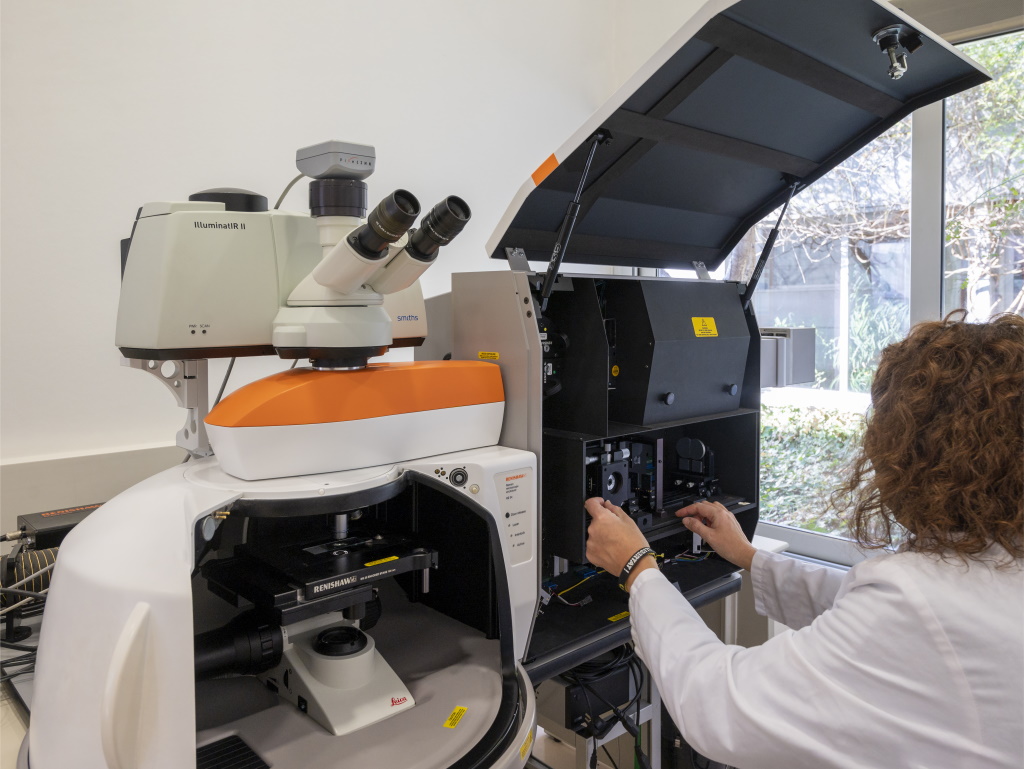
The SRCiT's confocal Raman microscope, an inVia Raman from Renishaw, is equipped with three diffraction gratings (2400, 1200 and 600 lines/mm), enabling optimization of spectral resolution and spectral range according to the requirements of each application. The system features three excitation lasers operating at 514, 633 and 785 nm, together with NExT filters for acquiring spectra in the low-wavenumber region (<100 cm⁻¹), which is essential for the characterization of crystalline materials, lattice vibrations and phase transitions.
The instrument also supports polarized Raman spectroscopy, allowing control of the polarization of the incident laser and analysis of the polarization of the scattered Raman signal. This capability enables the determination of vibrational mode symmetry, crystallographic orientation, optical anisotropy and the structural quality of crystals, thin films and two-dimensional materials.
The system is complemented by a confocal optical microscope, enabling the correlation of morphological and chemical information as well as high-spatial-resolution Raman mapping.
- Chemical identification and characterization of compounds in fields such as the pharmaceutical industry, materials science, coal industry, geology, biology, chemistry, cultural heritage conservation, and crystallography.
- Identification of unknown materials and discrimination between chemically similar materials. Determination of crystalline phases, quantification of amorphous phases, and evaluation of the degree of crystallinity.
- Structural characterization of materials, including chemical composition, vibrational properties, thin-film thickness, the number of layers in two-dimensional materials, crystallinity, the presence of structural defects, and the state of mechanical stress (compressive or tensile).
- Spatial analysis using Raman mapping to determine the distribution of chemical species, phase composition, particle or domain size and morphology, and material uniformity.
- Quantitative and semi-quantitative analysis of the relative concentration of compounds or chemical species, including the determination of mixtures and contaminants.
- In situ and operando studies through spectral acquisition during physical or chemical processes. Examples include temperature-dependent measurements (from room temperature up to 600 °C or higher, depending on the instrument), chemical reactions, crystallization processes, oxidation, and degradation.
- Polarized Raman spectroscopy: acquisition of Raman spectra by controlling the polarization of the incident light and analyzing the polarization of the scattered Raman signal. This technique enables the determination of vibrational mode symmetry, crystallographic orientation, optical anisotropy, and the structural quality of crystals, thin films, and two-dimensional materials.
- Characterization of two-dimensional (2D) materials, such as graphene, transition metal dichalcogenides, and hexagonal boron nitride, including determination of the number of layers, crystal quality, defects, doping, and mechanical stress.
- Analysis of mechanical stress and strain in semiconductor devices, ceramics, metals, coatings, and composite materials through Raman peak shifts.
- Studies of phase transitions, crystallization, polymorphic transformations, and structural changes induced by temperature, pressure, or other external stimuli.
- Quality control and forensic analysis, including the identification of contaminants, impurities, residues, pigments, fibers, microplastics, and other microscopic evidence without the need for sample preparation.
- Non-destructive analysis of solid, liquid, or biological samples, preserving sample integrity while allowing repeated measurements on the same region.
- Characterization of microelectronic and semiconductor devices, including silicon, SiC, GaN, and other advanced materials, to determine stress, crystal quality, layer uniformity, and film thickness.

-
Contact those
responsibles - Eric Pedrol Ripoll, Ph.D.
- 977558473
- eric.pedrol(ELIMINAR)@urv.cat
-
- Mercè Moncusí Mercadé
- 977558123
- merce.moncusi(ELIMINAR)@urv.cat
-
Technical coordinator
- Mercè Moncusí Mercadé
- 977558123
- merce.moncusi(ELIMINAR)@urv.cat
*Already registered on the User Portal?